


Page 186 - Profile's Unit Trusts & Collective Investments - September 2025
P. 186
Chapter 9                                              Fund manager interviews

              every two Millennial and Gen Z on the planet. Could Pop Mart become an IP powerhouse with
              a conveyor belt of viral sensations? Maybe. But with a market cap (USD54bn) already sitting
              at the top of the listed toy company peer group, we believe the downside is far more compelling
              than the upside.
         _ _ _ _ _ _ _ _ _ _ _ _ _ _ _ _ _ _ _ _ _ _ _ _ _ _ _ _ _ _ _ _ _ _ _ _ _ _ _ _ _ _ _ _ _ _ _ _ _ _ _ _ _ _ _ _ _ _ _ _ _ _ _
         Stylo Global Bond Prescient Fund of Funds

         Sector: Global–Interest Bearing–Variable Term
         Portfolio manager: David Shochot
         Benchmark: 80% Barclays Global Aggregate Bonds (USD); 15% Barclays Capital US TIPS; 4%
         Barclays Short Term Float Adjusted; 1% Cash

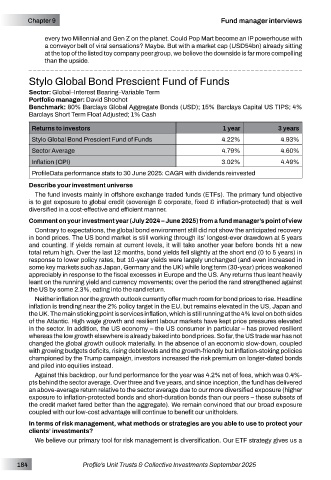
          Returns to investors                                  1 year          3 years
          Stylo Global Bond Prescient Fund of Funds             4.22%            4.93%
          Sector Average                                        4.79%            4.60%
          Inflation (CPI)                                       3.02%            4.49%
          ProfileData performance stats to 30 June 2025: CAGR with dividends reinvested
         Describe your investment universe
           The fund invests mainly in offshore exchange traded funds (ETFs). The primary fund objective
         is to get exposure to global credit (sovereign & corporate, fixed & inflation-protected) that is well
         diversified in a cost-effective and efficient manner.

         Comment on your investment year (July 2024 – June 2025) from a fund manager’s point of view
           Contrary to expectations, the global bond environment still did not show the anticipated recovery
         in bond prices. The US bond market is still working through its’ longest-ever drawdown at 5 years
         and  counting.  If  yields  remain  at  current  levels,  it  will  take  another  year  before  bonds  hit  a  new
         total return high. Over the last 12 months, bond yields fell slightly at the short end (0 to 5 years) in
         response to lower policy rates, but 10-year yields were largely unchanged (and even increased in
         some key markets such as Japan, Germany and the UK) while long term (30-year) prices weakened
         appreciably in response to the fiscal excesses in Europe and the US. Any returns thus leant heavily
         leant on the running yield and currency movements; over the period the rand strengthened against
         the US by some 2.3%, eating into the rand return.
           Neither inflation nor the growth outlook currently offer much room for bond prices to rise. Headline
         inflation is trending near the 2% policy target in the EU, but remains elevated in the US, Japan and
         the UK. The main sticking point is services inflation, which is still running at the 4% level on both sides
         of the Atlantic. High wage growth and resilient labour markets have kept price pressures elevated
         in the sector. In addition, the US economy – the US consumer in particular – has proved resilient
         whereas the low growth elsewhere is already baked into bond prices. So far, the US trade war has not
         changed the global growth outlook materially. In the absence of an economic slow-down, coupled
         with growing budgets deficits, rising debt levels and the growth-friendly but inflation-stoking policies
         championed by the Trump campaign, investors increased the risk premium on longer-dated bonds
         and piled into equities instead.
           Against this backdrop, our fund performance for the year was 4.2% net of fees, which was 0.4%-
         pts behind the sector average. Over three and five years, and since inception, the fund has delivered
         an above-average return relative to the sector average due to our more diversified exposure (higher
         exposure to inflation-protected bonds and short-duration bonds than our peers – these subsets of
         the credit market fared better than the aggregate). We remain convinced that our broad exposure
         coupled with our low-cost advantage will continue to benefit our unitholders.

         In terms of risk management, what methods or strategies are you able to use to protect your
         clients’ investments?
           We believe our primary tool for risk management is diversification. Our ETF strategy gives us a


      184                Profile’s Unit Trusts & Collective Investments September 2025

