


Page 117 - Profile's Unit Trusts & Collective Investments - September 2025
P. 117
Investment risk                                                       Chapter 6

           The Sharpe ratio is a direct measure of the amount of reward for each unit of risk. It helps to answer
         the logical question: was the return achieved worth the amount of risk taken?
           The calculation of the Sharpe ratio can be thought of in two steps:
           R   Step one is the calculation of a portfolio’s “excess” return above that of a “risk-free” investment.
              This is calculated by taking a portfolio’s average annual rate of return and subtracting a risk-
              free interest rate. This figure shows the “excess” return that a fund has achieved, and is also
              known as the “risk premium”.
           R   Step two shows the relationship between the risk premium and the level of risk taken. This is
              calculated by dividing the excess return by the fund’s standard deviation. Obviously, the higher
              the Sharpe ratio the more favourable the risk/reward profile of the portfolio.
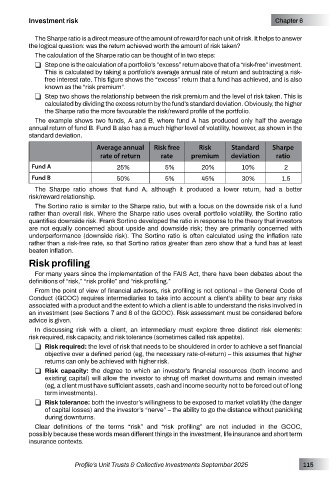
           The  example  shows  two  funds,  A  and  B,  where  fund  A  has  produced  only  half  the  average
         annual return of fund B. Fund B also has a much higher level of volatility, however, as shown in the
         standard deviation.
                            Average annual   Risk free    Risk     Standard   Sharpe
                              rate of return   rate    premium     deviation   ratio
          Fund A                  25%           5%        20%         10%         2
          Fund B                  50%           5%        45%         30%        1.5
           The  Sharpe  ratio  shows  that  fund  A,  although  it  produced  a  lower  return,  had  a  better
         risk/reward relationship.
           The Sortino ratio is similar to the Sharpe ratio, but with a focus on the downside risk of a fund
         rather  than  overall  risk.  Where  the  Sharpe  ratio  uses  overall  portfolio  volatility,  the  Sortino  ratio
         quantifies downside risk. Frank Sortino developed the ratio in response to the theory that investors
         are  not  equally  concerned  about  upside  and  downside  risk;  they  are  primarily  concerned  with
         underperformance  (downside  risk).  The  Sortino  ratio  is  often  calculated  using  the  inflation  rate
         rather than a risk-free rate, so that Sortino ratios greater than zero show that a fund has at least
         beaten inflation.
         Risk profiling
           For many years since the implementation of the FAIS Act, there have been debates about the
         definitions of “risk,” “risk profile” and “risk profiling.”
           From the point of view of financial advisers, risk profiling is not optional – the General Code of
         Conduct (GCOC) requires intermediaries to take into account a client’s ability to bear any risks
         associated with a product and the extent to which a client is able to understand the risks involved in
         an investment (see Sections 7 and 8 of the GCOC). Risk assessment must be considered before
         advice is given.
           In  discussing  risk  with  a  client,  an  intermediary  must  explore  three  distinct  risk  elements:
         risk required, risk capacity, and risk tolerance (sometimes called risk appetite).
           R   Risk required: the level of risk that needs to be shouldered in order to achieve a set financial
              objective over a defined period (eg, the necessary rate-of-return) – this assumes that higher
              returns can only be achieved with higher risk.
           R   Risk  capacity:  the  degree  to  which  an  investor’s  financial  resources  (both  income  and
              existing capital) will allow the investor to shrug off market downturns and remain invested
              (eg, a client must have sufficient assets, cash and income security not to be forced out of long
              term investments).
           R   Risk tolerance: both the investor’s willingness to be exposed to market volatility (the danger
              of capital losses) and the investor’s “nerve” – the ability to go the distance without panicking
              during downturns.
           Clear  definitions  of  the  terms  “risk”  and  “risk  profiling”  are  not  included  in  the  GCOC,
         possibly because these words mean different things in the investment, life insurance and short term
         insurance contexts.


                      Profile’s Unit Trusts & Collective Investments September 2025    115

