


Page 115 - Profile's Unit Trusts & Collective Investments - September 2025
P. 115
Investment risk                                                       Chapter 6

         but is, on average, less risky than equity sectors.   Figure 6.5: Risk/return profile
         General  equity  funds  have  a  higher  average
         volatility than Multi Asset sectors but, typically, a
         lower average than theme funds.
           In  short,  the  greater  the  equity  component,
         and  the  more  narrowly  focussed  that  equity
         component,  the  greater  the  volatility.  While  a
         useful rule of thumb, it must be remembered that
         there are many exceptions to this principle.
           Scatter  plots  are  often  used  to  compare  the
         relative  risk  and  return  of  different  funds  (see
         Figure  6.5).  The  lines  dividing  the  quadrants
         represent the average risk and the average return of funds represented in the figure. Return is plotted
         on the y-axis and risk, or volatility, on the x-axis. Ideally, a fund should be in the top left quadrant (A),
         giving above average returns at below average risk. Funds that have above average returns but are
         high risk fall into the top right quadrant (B). Funds with below average returns but low risk fall into
         the bottom left quadrant (C), and quadrant (D), the worst place to be, shows funds with higher than
         average risk and lower than average returns.
           As  with  all  historical  analysis,  past  performance  is  not  always  a  good  predictor  of  future
         performance (ie, today’s low risk high return star may be tomorrow’s high risk low return failure).
         Also, looking at the scatter graph for a single fund in isolation can be misleading (and for this reason,
         an attempt is made on the risk/return graphs shown for certain funds in the fact sheets in section
         two of this handbook to plot scatter charts on identical scales for the same periods.) Nevertheless,
         in the same way that historical performance figures give us a measure of a fund manager’s ability to
         generate consistent returns, volatility gives us a measure of the risk associated with a fund.

         Max drawdown
           Maximum (max) drawdown (often shortened to max DD or MDD) is a risk measure that expresses
         maximum loss on a peak to trough basis. A related figure, drawdown duration, is the longest time an
         investment took to regain a former peak.
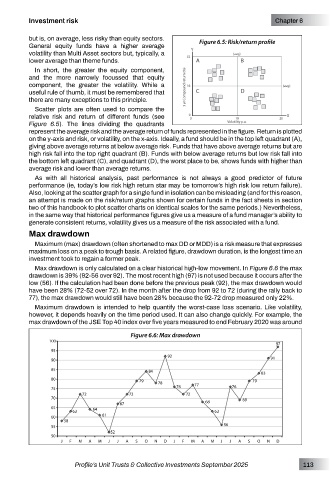
           Max drawdown is only calculated on a clear historical high-low movement. In Figure 6.6 the max
         drawdown is 39% (92-56 over 92). The most recent high (97) is not used because it occurs after the
         low (56). If the calculation had been done before the previous peak (92), the max drawdown would
         have been 28% (72-52 over 72). In the month after the drop from 92 to 72 (during the rally back to
         77), the max drawdown would still have been 28% because the 92-72 drop measured only 22%.
           Maximum  drawdown  is  intended  to  help  quantify  the  worst-case  loss  scenario.  Like  volatility,
         however, it depends heavily on the time period used. It can also change quickly. For example, the
         max drawdown of the JSE Top 40 index over five years measured to end February 2020 was around

                                      Figure 6.6: Max drawdown


                      Profile’s Unit Trusts & Collective Investments September 2025    113

