


Page 113 - Profile's Unit Trusts & Collective Investments - September 2025
P. 113
Investment risk                                                       Chapter 6

                          Table 6.1                         Figure 6.2: Risky Co. Ltd.
                        Risky Co. Ltd.  Stable Co. Ltd.
                        % return for   % return for
             Period       period       period
                1              16.36        14.48
                2              15.05         15.4
                3              16.55        13.92
                4              15.34        14.92
                5              18.78        14.95
                6              13.46        13.89
                7              12.12        14.31           Figure 6.3: Stable Co. Ltd.
                8              12.82        16.17
                9              15.96        15.05
               10              16.86         14.7
               11              12.15        14.37
               12              11.7         14.27
               13              17.31        16.14
               14              15.65         15.9
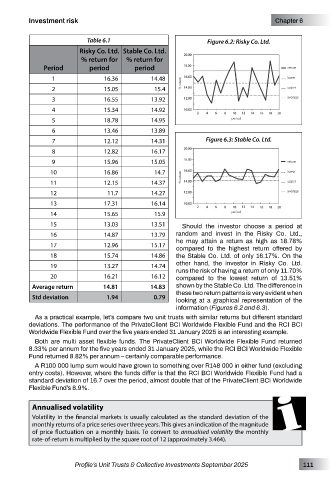
               15              13.03        13.51    Should  the  investor  choose  a  period  at
               16              14.87        13.79  random  and  invest  in  the  Risky  Co.  Ltd.,
               17              12.96        15.17  he  may  attain  a  return  as  high  as  18.78%
                                                   compared  to  the  highest  return  offered  by
               18              15.74        14.86  the  Stable  Co.  Ltd.  of  only  16.17%.  On  the
               19              13.27        14.74  other  hand,  the  investor  in  Risky  Co.  Ltd.
                                                   runs the risk of having a return of only 11.70%
               20              16.21        16.12  compared  to  the  lowest  return  of  13.51%
          Average return      14.81         14.83  shown by the Stable Co. Ltd. The difference in
                                                   these two return patterns is very evident when
          Std deviation        1.94          0.79  looking  at  a  graphical  representation  of  the
                                                   information (Figures 6.2 and 6.3).
           As a practical example, let’s compare two unit trusts with similar returns but different standard
         deviations. The performance of the PrivateClient BCI Worldwide Flexible Fund and the RCI BCI
         Worldwide Flexible Fund over the five years ended 31 January 2025 is an interesting example.
           Both  are  multi  asset  flexible  funds.  The  PrivateClient  BCI  Worldwide  Flexible  Fund  returned
         8.33% per annum for the five years ended 31 January 2025, while the RCI BCI Worldwide Flexible
         Fund returned 8.82% per annum – certainly comparable performance.
           A R100 000 lump sum would have grown to something over R148 000 in either fund (excluding
         entry costs). However, where the funds differ is that the RCI BCI Worldwide Flexible Fund had a
         standard deviation of 16.7 over the period, almost double that of the PrivateClient BCI Worldwide
         Flexible Fund’s 8.9%.

          Annualised volatility
          Volatility  in  the  financial  markets  is  usually  calculated  as  the  standard  deviation  of  the
          monthly returns of a price series over three years. This gives an indication of the magnitude
          of  price  fluctuation  on  a  monthly  basis. To  convert  to  annualised volatility the  monthly
          rate-of-return is multiplied by the square root of 12 (approximately 3.464).


                      Profile’s Unit Trusts & Collective Investments September 2025    111

