


Page 114 - Profile's Unit Trusts & Collective Investments - September 2025
P. 114
Chapter 6                                                       Investment risk


                  Quantitative vs qualitative
                  Most of the methods for evaluating risk mentioned in this section are quantitative – that is,
                  they are calculations based on quantifiable fund data. Quantitative analysis is essentially the
                  mathematical and statistical interrogation of data in order to measure performance, risk and
          other factors. Qualitative analysis, by contrast, depends on the subjective judgment of industry experts
          and  concerns  itself  with  factors  that  cannot  easily  be  quantified,  such  as  management  expertise,
          investment flair and economic cycles. Traders, researchers and fund managers who rely heavily on
          quantitative analysis are often referred to as “quants”, although the term is also used to describe the
          metrics of a fund or other investment vehicle.
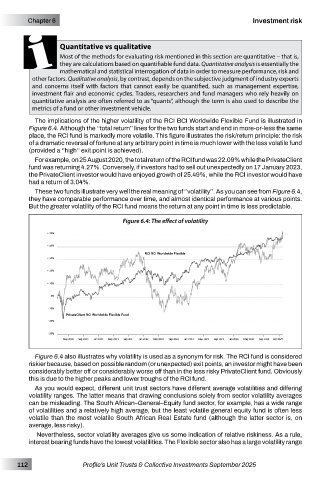
           The implications of the higher volatility of the RCI BCI Worldwide Flexible Fund is illustrated in
         Figure 6.4. Although the ‘’total return’’ lines for the two funds start and end in more-or-less the same
         place, the RCI fund is markedly more volatile. This figure illustrates the risk/return principle: the risk
         of a dramatic reversal of fortune at any arbitrary point in time is much lower with the less volatile fund
         (provided a ‘’high’’ exit point is achieved).
           For example, on 25 August 2020, the total return of the RCI fund was 22.09% while the PrivateClient
         fund was returning 4.27%. Conversely, if investors had to sell out unexpectedly on 17 January 2023,
         the PrivateClient investor would have enjoyed growth of 25.49%, while the RCI investor would have
         had a return of 3.04%.
           These two funds illustrate very well the real meaning of ‘’volatility’’. As you can see from Figure 6.4,
         they have comparable performance over time, and almost identical performance at various points.
         But the greater volatility of the RCI fund means the return at any point in time is less predictable.
                                    Figure 6.4: The effect of volatility


                                          RCI BCI Worldwide Flexible


                    PrivateClient BCI Worldwide Flexible Fund


           Figure 6.4 also illustrates why volatility is used as a synonym for risk. The RCI fund is considered
         riskier because, based on possible random (or unexpected) exit points, an investor might have been
         considerably better off or considerably worse off than in the less risky PrivateClient fund. Obviously
         this is due to the higher peaks and lower troughs of the RCI fund.
           As you would expect, different unit trust sectors have different average volatilities and differing
         volatility ranges. The latter means that drawing conclusions solely from sector volatility averages
         can be misleading. The South African–General–Equity fund sector, for example, has a wide range
         of volatilities and a relatively high average, but the least volatile general equity fund is often less
         volatile  than  the  most  volatile  South  African  Real  Estate  fund  (although  the  latter  sector  is,  on
         average, less risky).
            Nevertheless, sector volatility averages give us some indication of relative riskiness. As a rule,
         interest bearing funds have the lowest volatilities. The Flexible sector also has a large volatility range


      112                Profile’s Unit Trusts & Collective Investments September 2025

