


Page 120 - Profile's Unit Trusts & Collective Investments - September 2025
P. 120
Chapter 6 Investment risk
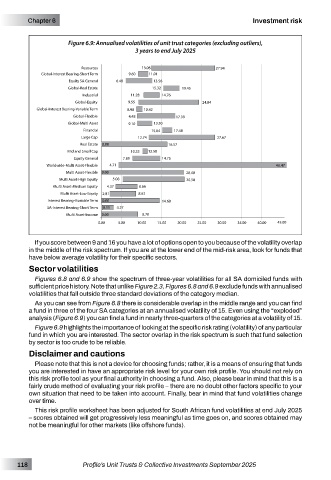
Figure 6.9: Annualised volatilities of unit trust categories (excluding outliers),
3 years to end July 2025
If you score between 9 and 16 you have a lot of options open to you because of the volatility overlap
in the middle of the risk spectrum. If you are at the lower end of the mid-risk area, look for funds that
have below average volatility for their specific sectors.
Sector volatilities
Figures 6.8 and 6.9 show the spectrum of three-year volatilities for all SA domiciled funds with
sufficient price history. Note that unlike Figure 2.3, Figures 6.8 and 6.9 exclude funds with annualised
volatilities that fall outside three standard deviations of the category median.
As you can see from Figure 6.8 there is considerable overlap in the middle range and you can find
a fund in three of the four SA categories at an annualised volatility of 15. Even using the “exploded”
analysis (Figure 6.9) you can find a fund in nearly three-quarters of the categories at a volatility of 15.
Figure 6.9 highlights the importance of looking at the specific risk rating (volatility) of any particular
fund in which you are interested. The sector overlap in the risk spectrum is such that fund selection
by sector is too crude to be reliable.
Disclaimer and cautions
Please note that this is not a device for choosing funds; rather, it is a means of ensuring that funds
you are interested in have an appropriate risk level for your own risk profile. You should not rely on
this risk profile tool as your final authority in choosing a fund. Also, please bear in mind that this is a
fairly crude method of evaluating your risk profile – there are no doubt other factors specific to your
own situation that need to be taken into account. Finally, bear in mind that fund volatilities change
over time.
This risk profile worksheet has been adjusted for South African fund volatilities at end July 2025
– scores obtained will get progressively less meaningful as time goes on, and scores obtained may
not be meaningful for other markets (like offshore funds).
118 Profile’s Unit Trusts & Collective Investments September 2025

