


Page 125 - Profile's Unit Trusts & Collective Investments - September 2025
P. 125
Understanding asset allocation Chapter 7
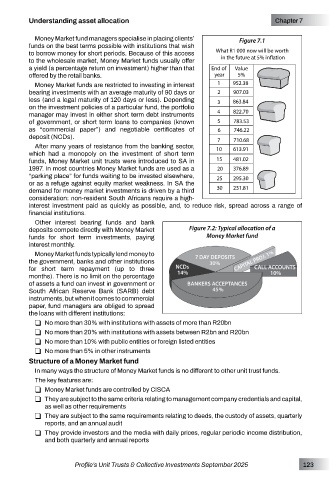
Money Market fund managers specialise in placing clients’ Figure 7.1
funds on the best terms possible with institutions that wish
to borrow money for short periods. Because of this access
to the wholesale market, Money Market funds usually offer
a yield (a percentage return on investment) higher than that
offered by the retail banks.
Money Market funds are restricted to investing in interest
bearing investments with an average maturity of 90 days or
less (and a legal maturity of 120 days or less). Depending
on the investment policies of a particular fund, the portfolio
manager may invest in either short term debt instruments
of government, or short term loans to companies (known
as “commercial paper”) and negotiable certificates of
deposit (NCDs).
After many years of resistance from the banking sector,
which had a monopoly on the investment of short term
funds, Money Market unit trusts were introduced to SA in
1997. In most countries Money Market funds are used as a
“parking place” for funds waiting to be invested elsewhere,
or as a refuge against equity market weakness. In SA the
demand for money market investments is driven by a third
consideration: non-resident South Africans require a high-
interest investment paid as quickly as possible, and, to reduce risk, spread across a range of
financial institutions.
Other interest bearing funds and bank
deposits compete directly with Money Market Figure 7.2: Typical allocation of a
funds for short term investments, paying Money Market fund
interest monthly.
Money Market funds typically lend money to
the government, banks and other institutions
for short term repayment (up to three
months). There is no limit on the percentage
of assets a fund can invest in government or
South African Reserve Bank (SARB) debt
instruments, but when it comes to commercial
paper, fund managers are obliged to spread
the loans with different institutions:
R No more than 30% with institutions with assets of more than R20bn
R No more than 20% with institutions with assets between R2bn and R20bn
R No more than 10% with public entities or foreign listed entities
R No more than 5% in other instruments
Structure of a Money Market fund
In many ways the structure of Money Market funds is no different to other unit trust funds.
The key features are:
R Money Market funds are controlled by CISCA
R They are subject to the same criteria relating to management company credentials and capital,
as well as other requirements
R They are subject to the same requirements relating to deeds, the custody of assets, quarterly
reports, and an annual audit
R They provide investors and the media with daily prices, regular periodic income distribution,
and both quarterly and annual reports
Profile’s Unit Trusts & Collective Investments September 2025 123

