


Page 193 - Profile's Unit Trusts & Collective Investments - September 2025
P. 193
Fact sheet tips

           All rates of return are expressed as nominal (rather than effective) rates. This is consistent with the
         way that interest rates are generally quoted in the retail banking environment in SA.
           Each performance table also shows the growth in a R1 000 lump sum or R100 per month invested
         at  the  inflation  rate.  The  official  consumer  price  index  (CPI)  is  used.  This  shows  how  much  an
         equivalent investment has had to increase to retain the same buying power.
           Finally, each performance table shows historical volatility. This gives an indication of the riskiness
         of the fund. Note that the three-year figure is generally regarded as the fairest indicator of “average”
         volatility – this is the figure we recommend for comparing funds. To calculate volatility we use the
         standard deviation of monthly returns on the NAV price.

         Reinvestment of income (dividends and interest)
           Income for unit trusts is usually declared and paid out quarterly or twice yearly. A few unit trusts
         pay annual income and some pay monthly. It is obviously important to take the timing of differing
         income declarations into account when comparing one unit trust with another. It is also important to
         take into account the date on which the income is reinvested.
           Different  stats  houses  have  different  ways  of  accounting  for  income  declarations  in  their
         calculations.  Some  follow  the  international  norm  of  reinvesting  the  income  on  the  declaration
         date, whereas others follow the South African convention of reinvesting the income on the actual
         reinvestment date. There can be as much as four weeks difference between these two dates, but on
         average it differs by a week or two.
           In this handbook we calculate returns based on the actual reinvestment date – and the actual
         reinvestment price which ruled on that day. This is the most accurate performance measure possible.
           For calculation of performance data, the full (gross) distribution amount is applied to the purchase
         of additional units (ie, no deduction is made for DWT). The actual rate of return of an individual investor
         subject to DWT will, after April 2012, therefore be slightly lower than the reported performance figure.
         Performance figures for money market funds
           Money market fund yields, as quoted in the daily press, are based on an average yield over seven
         days. This is to provide investors with an up-to-date figure based on recent performance that gives
         an indication of the yield that might be expected for a short term deposit.
           For the historical perspective which this book provides, a different approach is obviously warranted.
         We use the actual monthly interest payments made by the money market fund, and convert these to
         the equivalent of an annual interest rate paid monthly. The rationale is that this is the most common
         way of quoting interest rates in the retail banking environment, and therefore gives a simple and
         consistent basis for comparison.
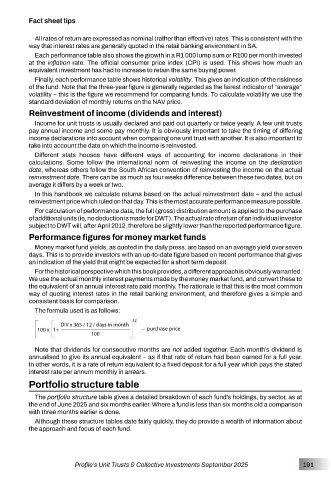
           The formula used is as follows:


           Note that dividends for consecutive months are not added together. Each month’s dividend is
         annualised to give its annual equivalent – as if that rate of return had been earned for a full year.
         In other words, it is a rate of return equivalent to a fixed deposit for a full year which pays the stated
         interest rate per annum monthly in arrears.
         Portfolio structure table

           The portfolio structure table gives a detailed breakdown of each fund’s holdings, by sector, as at
         the end of June 2025 and six months earlier. Where a fund is less than six months old a comparison
         with three months earlier is done.
           Although these structure tables date fairly quickly, they do provide a wealth of information about
         the approach and focus of each fund.


                      Profile’s Unit Trusts & Collective Investments September 2025    191

