


Page 196 - Profile's Unit Trusts & Collective Investments - September 2025
P. 196
Fact sheet tips


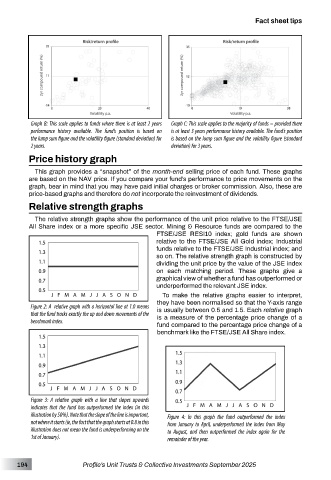
          Graph B: This scale applies to funds where there is at least 2 years   Graph C: This scale applies to the majority of funds – provided there
          performance  history  available.  The  fund’s  position  is  based  on     is at least 3 years performance history available. The fund’s position
          the lump sum figure and the volatility figure (standard deviation) for   is based on the lump sum figure and the volatility figure (standard
          2 years.                                deviation) for 3 years.

         Price history graph
           This  graph  provides  a  “snapshot”  of  the  month-end  selling  price  of  each  fund.  These  graphs
         are based on the NAV price. If you compare your fund’s performance to price movements on the
         graph, bear in mind that you may have paid initial charges or broker commission. Also, these are
         price-based graphs and therefore do not incorporate the reinvestment of dividends.
         Relative strength graphs
           The relative strength graphs show the performance of the unit price relative to the FTSE/JSE
         All  Share  index  or  a  more  specific  JSE  sector.  Mining  &  Resource  funds  are  compared  to  the
                                             FTSE/JSE  RESI10  index;  gold  funds  are  shown
                                             relative  to  the  FTSE/JSE  All  Gold  index;  Industrial
                                             funds relative to the FTSE/JSE Industrial index; and
                                             so on. The relative strength graph is constructed by
                                             dividing the unit price by the value of the JSE index
                                             on  each  matching  period.  These  graphs  give  a
                                             graphical view of whether a fund has outperformed or
                                             underperformed the relevant JSE index.
                                               To  make  the  relative  graphs  easier  to  interpret,
                                              they have been normalised so that the Y-axis range
          Figure 2: A  relative graph with a horizontal line at 1.0 means   is usually between 0.5 and 1.5. Each relative graph
          that the fund tracks exactly the up and down movements of the   is  a  measure  of  the  percentage  price  change  of  a
          benchmark index.                    fund compared to the percentage price change of a
                                              benchmark like the FTSE/JSE All Share index.


          Figure  3:  A  relative  graph  with  a  line  that  slopes  upwards
          indicates  that  the  fund  has  outperformed  the  index  (in  this
          illustration by 50%). Note that the slope of the line is important,   Figure  4:  In  this  graph  the  fund  outperformed  the  index
          not where it starts (ie, the fact that the graph starts at 0.8 in this   from  January  to  April,  underperformed  the  index  from  May
          illustration does not mean the fund is underperforming on the   to  August,  and  then  outperformed  the  index  again  for  the
          1st of January).                       remainder of the year.


      194                Profile’s Unit Trusts & Collective Investments September 2025

