


Page 166 - Profile's Unit Trusts & Collective Investments - September 2025
P. 166
Chapter 9                                              Fund manager interviews

         our credit process to assess credit risk before we assume the exposure. The fund, being a money
         market fund and low risk by nature, high-quality issuers or instruments are preferred for inclusion in
         the portfolio.
           The fund is managed according to the guidelines provided by the mandate, diligently maintaining
         adequate liquidity levels while keeping return volatility low. Term risk is carefully monitored, ensuring
         that  the  weighted  average  duration  remains  within  limits  and  is  adjusted  as  the  interest  rate
         environment changes.

         Comment on the year ahead and, if possible, estimate the performance of your fund over 2 or
         3 years. What are your targets and objectives for the year ahead?
           Growth,  as  measured  by  GDP,  is  expected  to  remain  below  long-run  historical  averages  due
         to persistent structural challenges in the country. Earlier in the year, we were more optimistic that
         improved reliability from Eskom’s electricity supply, combined with accelerated private investment
         in  renewable  energy  and  stronger  maintenance  efforts,  would  improve  business  conditions  and
         support growth. However, we have since revised our growth expectations lower for 2025 and the
         outer years, as global tariff pressures have created a highly unpredictable environment and domestic
         economic activity has been weaker than anticipated.
           While it is not the nature of a money market fund to predict returns, we take pride in our consistent
         ability to deliver inflation-beating performance within mandate parameters. This remains exactly
         what is required from this asset class.

         Give your views regarding interest rate trends and the yield curve over the next 1 to 2 years.
         What interest rates can investors expect? Do you anticipate further repo rate cuts?
           At the July 2025 Monetary Policy Meeting, the governor announced that the SARB will now aim
         to anchor inflation expectations at the lower end of the official 3% to 6% target range set by the
         National Treasury, at 3%, rather than the previous midpoint of 4.5%. This decision followed extensive
         consultation and research, which highlighted that South Africa is an outlier among emerging market
         peers  due  to  one  of  the  widest  inflation  target  ranges.  The  analysis  also  showed  that  this  has
         contributed to relatively higher general price levels compared to other emerging markets.
           Although inflation may edge higher as fuel price base effects fade and food inflation rises, we
         believe it remains well contained for the foreseeable future, supported by relatively stable oil prices,
         a stable rand, and lower inflation expectations following the revised target.
           Looking ahead over the next two years, we expect continued central bank action domestically.
         The  SARB’s  Quarterly  Projection  Model  (QPM),  which  forecasts  key  variables  such  as  inflation
         and  output  growth  by  combining  historical  data  with  structural  economic  relationships,  projects
         lower inflation under this 3% anchoring scenario. This should provide room for further monetary
         accommodation through gradual rate cuts over the next two years.
         _ _ _ _ _ _ _ _ _ _ _ _ _ _ _ _ _ _ _ _ _ _ _ _ _ _ _ _ _ _ _ _ _ _ _ _ _ _ _ _ _ _ _ _ _ _ _ _ _ _ _ _ _ _ _ _ _ _ _ _ _ _ _
         H4 Stable Fund

         Sector: South African–Multi Asset–Low Equity
         Portfolio manager: Yolanda Naudé
         Benchmark: (ASISA) SA MA Low Equity peer group average

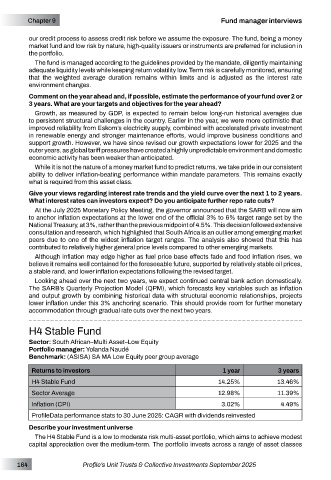
          Returns to investors                                  1 year          3 years
          H4 Stable Fund                                       14.25%           13.46%
          Sector Average                                       12.98%           11.39%
          Inflation (CPI)                                       3.02%            4.49%
          ProfileData performance stats to 30 June 2025: CAGR with dividends reinvested
         Describe your investment universe
           The H4 Stable Fund is a low to moderate risk multi-asset portfolio, which aims to achieve modest
         capital appreciation over the medium-term. The portfolio invests across a range of asset classes


      164                Profile’s Unit Trusts & Collective Investments September 2025

