


Page 60 - Profile's Unit Trusts & Collective Investments - March 2026
P. 60
Chapter 3                                                     Costs and pricing

           The  EAC  comprises  four  components  which  are  calculated  separately  and  then  combined  to
         reflect the total EAC:
           R   Investment management charges (IMC): costs and charges associated with management of
              all underlying investment portfolios
           R   Advice charges: initial and annual fees, both lump sum and recurring
           R   Administration charges: all costs of administration
           R   Other charges: a category for all remaining costs, including exit charges, penalties, loyalty
              bonuses, guarantees, smoothing or risk benefits, wrap fund charges and risk benefits (such
              as waiver of premium)
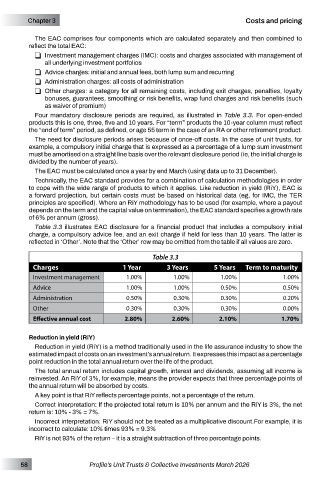
           Four  mandatory  disclosure  periods  are  required,  as  illustrated  in  Table  3.3.  For  open-ended
         products this is one, three, five and 10 years. For “term” products the 10-year column must reflect
         the “end of term” period, as defined, or age 55 term in the case of an RA or other retirement product.
           The need for disclosure periods arises because of once-off costs. In the case of unit trusts, for
         example, a compulsory initial charge that is expressed as a percentage of a lump sum investment
         must be amortised on a straight line basis over the relevant disclosure period (ie, the initial charge is
         divided by the number of years).
           The EAC must be calculated once a year by end March (using data up to 31 December).
           Technically, the EAC standard provides for a combination of calculation methodologies in order
         to cope with the wide range of products to which it applies. Like reduction in yield (RiY), EAC is
         a  forward  projection,  but  certain  costs  must  be  based  on  historical  data  (eg,  for  IMC,  the  TER
         principles are specified). Where an RiY methodology has to be used (for example, where a payout
         depends on the term and the capital value on termination), the EAC standard specifies a growth rate
         of 6% per annum (gross).
           Table  3.3  illustrates  EAC  disclosure  for  a  financial  product  that  includes  a  compulsory  initial
         charge, a compulsory advice fee, and an exit charge if held for less than 10 years. The latter is
         reflected in ‘Other’. Note that the ‘Other’ row may be omitted from the table if all values are zero.

                                            Table 3.3
          Charges                   1 Year      3 Years       5 Years  Term to maturity
          Investment management      1.00%        1.00%         1.00%            1.00%
          Advice                     1.00%        1.00%         0.50%            0.50%
          Administration             0.50%        0.30%         0.30%            0.20%
          Other                      0.30%        0.30%         0.30%            0.00%
          Effective annual cost     2.80%         2.60%        2.10%             1.70%

         Reduction in yield (RiY)
           Reduction in yield (RiY) is a method traditionally used in the life assurance industry to show the
         estimated impact of costs on an investment’s annual return. It expresses this impact as a percentage
         point reduction in the total annual return over the life of the product.
           The total annual return includes capital growth, interest and dividends, assuming all income is
         reinvested. An RiY of 3%, for example, means the provider expects that three percentage points of
         the annual return will be absorbed by costs.
           A key point is that RiY reflects percentage points, not a percentage of the return.
           Correct interpretation: If the projected total return is 10% per annum and the RiY is 3%, the net
         return is: 10% - 3% = 7%.
           Incorrect interpretation: RiY should not be treated as a multiplicative discount.For example, it is
         incorrect to calculate: 10% times 93% = 9.3%
           RiY is not 93% of the return – it is a straight subtraction of three percentage points.


       58                 Profile’s Unit Trusts & Collective Investments March 2026

