


Page 115 - Profile's Unit Trusts & Collective Investments - March 2026
P. 115
Investment risk                                                       Chapter 6


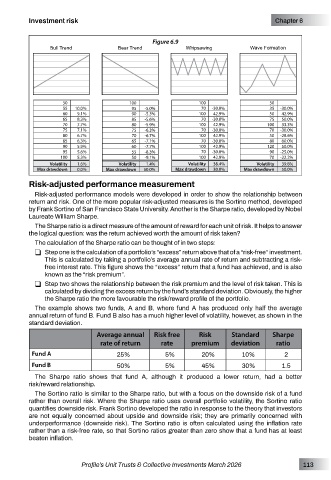
                                            Figure 6.9
               Bull Trend          Bear Trend         Whipsawing        Wave Formation


                   50                 100                 100                 50
                   55  10.0%          95  -5.0%           70  -30.0%          35  -30.0%
                   60  9.1%           90  -5.3%           100  42.9%          50  42.9%
                   65  8.3%           85  -5.6%           70  -30.0%          75  50.0%
                   70  7.7%           80  -5.9%           100  42.9%         100  33.3%
                   75  7.1%           75  -6.3%           70  -30.0%          70  -30.0%
                   80  6.7%           70  -6.7%           100  42.9%          50  -28.6%
                   85  6.3%           65  -7.1%           70  -30.0%          80  60.0%
                   90  5.9%           60  -7.7%           100  42.9%         120  50.0%
                   95  5.6%           55  -8.3%           70  -30.0%          90  -25.0%
                  100  5.3%           50  -9.1%           100  42.9%          70  -22.2%
               Volatility  1.6%    Volatility  1.4%    Volatility  38.4%  Volatility  39.8%
            Max drawdown  0.0%  Max drawdown  50.0%  Max drawdown  30.0%  Max drawdown  50.0%
         Risk-adjusted performance measurement
           Risk-adjusted performance models were developed in order to show the relationship between
         return and risk. One of the more popular risk-adjusted measures is the Sortino method, developed
         by Frank Sortino of San Francisco State University. Another is the Sharpe ratio, developed by Nobel
         Laureate William Sharpe.
           The Sharpe ratio is a direct measure of the amount of reward for each unit of risk. It helps to answer
         the logical question: was the return achieved worth the amount of risk taken?
           The calculation of the Sharpe ratio can be thought of in two steps:
           R   Step one is the calculation of a portfolio’s “excess” return above that of a “risk-free” investment.
              This is calculated by taking a portfolio’s average annual rate of return and subtracting a risk-
              free interest rate. This figure shows the “excess” return that a fund has achieved, and is also
              known as the “risk premium”.
           R   Step two shows the relationship between the risk premium and the level of risk taken. This is
              calculated by dividing the excess return by the fund’s standard deviation. Obviously, the higher
              the Sharpe ratio the more favourable the risk/reward profile of the portfolio.
           The  example  shows  two  funds,  A  and  B,  where  fund  A  has  produced  only  half  the  average
         annual return of fund B. Fund B also has a much higher level of volatility, however, as shown in the
         standard deviation.
                             Average annual   Risk free   Risk     Standard   Sharpe
                              rate of return   rate    premium     deviation    ratio
          Fund A                  25%           5%        20%         10%         2
          Fund B                  50%           5%        45%         30%        1.5
           The  Sharpe  ratio  shows  that  fund  A,  although  it  produced  a  lower  return,  had  a  better
         risk/reward relationship.
           The Sortino ratio is similar to the Sharpe ratio, but with a focus on the downside risk of a fund
         rather  than  overall  risk.  Where  the  Sharpe  ratio  uses  overall  portfolio  volatility,  the  Sortino  ratio
         quantifies downside risk. Frank Sortino developed the ratio in response to the theory that investors
         are  not  equally  concerned  about  upside  and  downside  risk;  they  are  primarily  concerned  with
         underperformance  (downside  risk).  The  Sortino  ratio  is  often  calculated  using  the  inflation  rate
         rather than a risk-free rate, so that Sortino ratios greater than zero show that a fund has at least
         beaten inflation.


                        Profile’s Unit Trusts & Collective Investments March 2026      113

