


Page 27 - Profile's Unit Trusts & Collective Investments - September 2025
P. 27
History of collective investment schemes                              Chapter 1


          The advert which appeared in the Financial Mail in June 1965 proclaimed the launch of SA’s
          first mutual fund. It was constituted under the Unit Trusts Control Act, 1947 as amended.
          The  term  mutual  fund,  which  is  what  unit  trusts  are  called  in  the  US,  carried  positive
          connotations from the American market, where these products had offered investors good
          returns for many years.
          The differences between mutual funds and unit trusts lie in their structure; the end result for the
          investor is much the same.
          On a simple level, a unit trust is established as a trust, while a mutual fund has the structure of a
          limited liability company. A unit trust is overseen by a trustee company, while in a mutual fund it is the
          responsibility of the directors of the mutual fund company to ensure that the fund manager and the
          custodian perform their duties in accordance with the constituting documents.
         Donald Gordon, Liberty, Nedbank, and several personal friends of Shill and Gordon. Initial assets of
         the fund were R600 000.
           The  fledgling  industry  grew  relatively  quickly.  It  offered  investors  professional  management  of
         assets, spread of risk across a broad portfolio of shares, the ability to liquidate the investment on
         demand, low initial investment amounts, tax effectiveness, and low costs compared to other products
         available at the time.
         The crash of 1969
           The 1960s bull run lifted the local market by some 450% between 1961 and 1969, much of the
         action occurring in the last two years. By May 1969, the peak of the share market boom, assets under
         management in the new unit trust industry had climbed to not far short of R1bn. Inflows showed a
         strong rising trend: R45m in 1967, R141m in 1968. The strength of the bull market in the late 1960s is
         illustrated by the fact that industry sales in May of 1969 – just one month – leaped to R562m.
           Like nearly all stock market declines in SA, the crash of 1969 was triggered by a fall in US markets
         (in turn triggered by rising inflation, increased deficits from the Vietnam War, monetary tightening
         and economic recession). SA’s bull run had been more sustained than that in the US and as a result
         the crash in SA was more severe. The SA market also took longer to recover.
           The intensity of the final phase of the bull run in SA was, however, to have an unfortunate impact
         on the industry. The bubble that finally burst in May 1969 left deep scars in the industry, which, quite
         literally, took over 10 years to recover. Between May 1969 and October 1971 the JSE fell over 60%.
         It was not until 1983 that industry assets surpassed their May 1969 level.
           The virtual hibernation of the unit trust industry after the 1969 crash was due to a number of factors:
           R   The  regulatory  authorities  adopted  a  more  cautious  approach,  and  discouraged  the
              management companies from resuming active marketing of unit trusts.
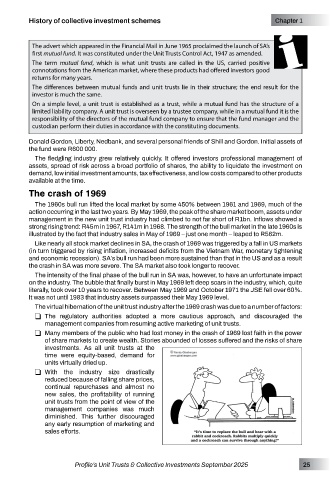
           R   Many members of the public who had lost money in the crash of 1969 lost faith in the power
              of share markets to create wealth. Stories abounded of losses suffered and the risks of share
              investments.  As  all  unit  trusts  at  the
              time  were  equity-based,  demand  for
              units virtually dried up.
           R   With  the  industry  size  drastically
              reduced because of falling share prices,
              continual  repurchases  and  almost  no
              new  sales,  the  profitability  of  running
              unit trusts from the point of view of the
              management  companies  was  much
              diminished.  This  further  discouraged
              any early resumption of marketing and
              sales efforts.


                      Profile’s Unit Trusts & Collective Investments September 2025    25

