


Page 81 - Profile's Unit Trusts & Collective Investments - September 2025
P. 81
The CIS industry                                                      Chapter 4


          Tied brokers, IFAs and RDR
          Independent financial advisers (IFAs) are brokers who are licensed to place investments with
          more than one product supplier. A tied broker, on the other hand, is a financial adviser who
          sells products for a single supplier. But IFAs, although nominally independent, are often
          incentivised by product suppliers in various ways, and these incentives can introduce bias. The FSCA
          has made changes to the General Code of Conduct under the FAIS Act that oblige advisers to declare
          any conflicts, to declare if they earn more than 30% of their remuneration from a single source and to
          ban the acceptance of any establishment fees and incentives from product providers.
          The Conduct of Financial Institutions (COFI) Bill is likely to also include new labels for financial advisers
          that will oblige them to disclose to investors the level of their independence from product providers.
          The proposals so far suggest product supplier agent (PSA) for tied broker and registered financial
          adviser (RFA) in place of IFA.

           The  introduction  from  September  2024  of
         the  two-pot  retirement  system  is  expected
         to  result  over  time  in  greater  preservation
         of  retirement  savings  as  two-thirds  of  all
         contributions  made  by  members  of  most
         funds after this date will have to be preserved
         until  retirement.  Currently,  members  are
         allowed  and  typically  do,  withdraw  all  their
         savings when they resign.
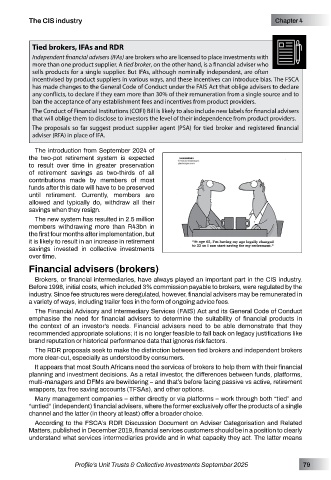
           The new system has resulted in 2.5 million
         members  withdrawing  more  than  R43bn  in
         the first four months after implementation, but
         it is likely to result in an increase in retirement
         savings  invested  in  collective  investments
         over time.

         Financial advisers (brokers)
           Brokers, or financial intermediaries, have always played an important part in the CIS industry.
         Before 1998, initial costs, which included 3% commission payable to brokers, were regulated by the
         industry. Since fee structures were deregulated, however, financial advisers may be remunerated in
         a variety of ways, including trailer fees in the form of ongoing advice fees.
           The Financial Advisory and Intermediary Services (FAIS) Act and its General Code of Conduct
         emphasise  the  need  for  financial  advisers  to  determine  the  suitability  of  financial  products  in
         the  context  of  an  investor’s  needs.  Financial  advisers  need  to  be  able  demonstrate  that  they
         recommended appropriate solutions; it is no longer feasible to fall back on legacy justifications like
         brand reputation or historical performance data that ignores risk factors.
           The RDR proposals seek to make the distinction between tied brokers and independent brokers
         more clear-cut, especially as understood by consumers.
           It appears that most South Africans need the services of brokers to help them with their financial
         planning and investment decisions. As a retail investor, the differences between funds, platforms,
         multi-managers and DFMs are bewildering – and that’s before facing passive vs active, retirement
         wrappers, tax free saving accounts (TFSAs), and other options.
           Many management companies – either directly or via platforms – work through both “tied” and
         “untied” (independent) financial advisers, where the former exclusively offer the products of a single
         channel and the latter (in theory at least) offer a broader choice.
           According  to  the  FSCA’s  RDR  Discussion  Document  on  Adviser  Categorisation  and  Related
         Matters, published in December 2019, financial services customers should be in a position to clearly
         understand what services intermediaries provide and in what capacity they act. The latter means


                      Profile’s Unit Trusts & Collective Investments September 2025    79

