


Page 54 - Profile's Unit Trusts & Collective Investments - September 2025
P. 54
Chapter 3                                                     Costs and pricing


         Chapter 3

         Costs and pricing
                                                                              NQF
                                                                              Relevant to
         The importance of costs                                              243130: 2
           Investors should never be blasé about the costs of investment management and   243135: 1 - 3
         administration. The fees paid to asset managers and fund administrators are a direct   243141: 1 - 4
                                                                              243148: 2
         charge against investment performance, and can have a significant impact on returns.
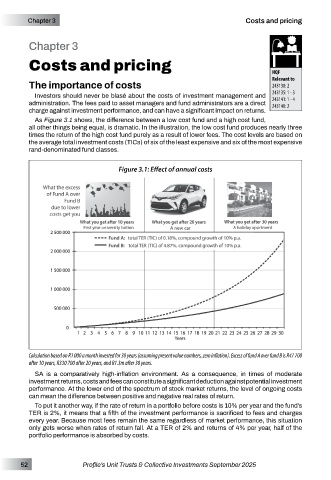
           As Figure 3.1 shows, the difference between a low cost fund and a high cost fund,
         all other things being equal, is dramatic. In the illustration, the low cost fund produces nearly three
         times the return of the high cost fund purely as a result of lower fees. The cost levels are based on
         the average total investment costs (TICs) of six of the least expensive and six of the most expensive
         rand-denominated fund classes.

                                   Figure 3.1: Effect of annual costs


         Calculation based on R1 000 a month invested for 30 years (assuming present value numbers, zero inflation). Excess of fund A over fund B is R47 700
         after 10 years, R330 700 after 20 years, and R1.3m after 30 years.
           SA  is  a  comparatively  high-inflation  environment.  As  a  consequence,  in  times  of  moderate
         investment returns, costs and fees can constitute a significant deduction against potential investment
         performance. At the lower end of the spectrum of stock market returns, the level of ongoing costs
         can mean the difference between positive and negative real rates of return.
           To put it another way, if the rate of return in a portfolio before costs is 10% per year and the fund’s
         TER is 2%, it means that a fifth of the investment performance is sacrificed to fees and charges
         every year. Because most fees remain the same regardless of market performance, this situation
         only gets worse when rates of return fall. At a TER of 2% and returns of 4% per year, half of the
         portfolio performance is absorbed by costs.


       52                Profile’s Unit Trusts & Collective Investments September 2025

