


Page 35 - Profile's Unit Trusts & Collective Investments - September 2025
P. 35
History of collective investment schemes                              Chapter 1

         category  emerged  in  2008.  Global  robo-advice
         assets  under  management  (AUM)  have  grown
         dramatically and now represent a sizeable segment
         of the market, especially in the US.
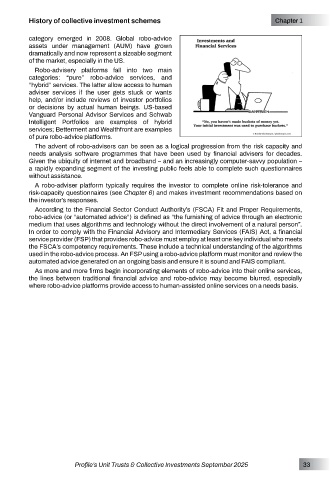
           Robo-advisery  platforms  fall  into  two  main
         categories:  “pure”  robo-advice  services,  and
         “hybrid” services. The latter allow access to human
         adviser  services  if  the  user  gets  stuck  or  wants
         help,  and/or  include  reviews  of  investor  portfolios
         or  decisions  by  actual  human  beings.  US-based
         Vanguard  Personal  Advisor  Services  and  Schwab
         Intelligent  Portfolios  are  examples  of  hybrid
         services; Betterment and Wealthfront are examples
         of pure robo-advice platforms.
           The  advent  of  robo-advisers  can  be  seen  as  a  logical  progression  from  the  risk  capacity  and
         needs  analysis  software  programmes  that  have  been  used  by  financial  advisers  for  decades.
         Given the ubiquity of internet and broadband – and an increasingly computer-savvy population –
         a rapidly expanding segment of the investing public feels able to complete such questionnaires
         without assistance.
           A  robo-adviser  platform  typically  requires  the  investor  to  complete  online  risk-tolerance  and
         risk-capacity questionnaires (see Chapter 6) and makes investment recommendations based on
         the investor’s responses.
           According  to  the  Financial  Sector  Conduct  Authority’s  (FSCA)  Fit  and  Proper  Requirements,
         robo-advice (or “automated advice”) is defined as “the furnishing of advice through an electronic
         medium that uses algorithms and technology without the direct involvement of a natural person”.
         In order to comply with the Financial Advisory and Intermediary Services (FAIS) Act, a financial
         service provider (FSP) that provides robo-advice must employ at least one key individual who meets
         the FSCA’s competency requirements. These include a technical understanding of the algorithms
         used in the robo-advice process. An FSP using a robo-advice platform must monitor and review the
         automated advice generated on an ongoing basis and ensure it is sound and FAIS compliant.
           As more and more firms begin incorporating elements of robo-advice into their online services,
         the  lines  between  traditional  financial  advice  and  robo-advice  may  become  blurred,  especially
         where robo-advice platforms provide access to human-assisted online services on a needs basis.


                      Profile’s Unit Trusts & Collective Investments September 2025    33

