


Page 20 - Profile's Unit Trusts & Collective Investments - September 2025
P. 20
How to use this book

         A note on terminology
           Both the Collective Investment Schemes Control Act (CISCA) and the National Qualifications
         Framework (NQF) introduced new terminology which should be used where possible.
           The term “learner”, for example, has been adopted, perhaps because it is more encompassing
         than old terminology like “scholar” (someone who is at school) or “student” (which tends to imply
         attendance  at  college  or  university).  “Learner”  encompasses  something  of  the  old  concept  of
         “apprentice” (ie, a student who receives on-the-job training and experience).
           An example from CISCA is the use of “portfolio” to describe what has always been called a “fund”.
         In other words, a unit trust fund is now correctly called a portfolio of a collective investment scheme,
         although fund remains popular and widely used. Another example: what was called a “unit” (in a
         “fund”) is now correctly called a participatory interest in a collective investment scheme.
           To assist readers in not getting confused with the new terminology, notes, sidebars and definitions
         in the text highlight old and new terms and give examples of usage.
         Conventions used in the chapters
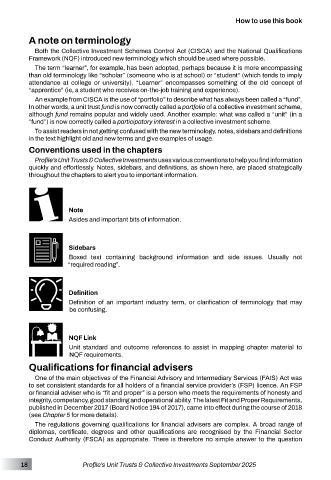
           Profile’s Unit Trusts & Collective Investments uses various conventions to help you find information
         quickly and effortlessly. Notes, sidebars, and definitions, as shown here, are placed strategically
         throughout the chapters to alert you to important information.


                     Note
                     Asides and important bits of information.


                     Sidebars
                     Boxed  text  containing  background  information  and  side  issues.  Usually  not
                       “required reading”.


                     Definition
                     Definition  of  an  important  industry  term,  or  clarification  of  terminology  that  may
                        be confusing.


                     NQF Link
                     Unit  standard  and  outcome  references  to  assist  in  mapping  chapter  material  to
                        NQF requirements.
         Qualifications for financial advisers
           One of the main objectives of the Financial Advisory and Intermediary Services (FAIS) Act was
         to set consistent standards for all holders of a financial service provider’s (FSP) licence. An FSP
         or financial adviser who is “fit and proper” is a person who meets the requirements of honesty and
         integrity, competancy, good standing and operational ability. The latest Fit and Proper Requirements,
         published in December 2017 (Board Notice 194 of 2017), came into effect during the course of 2018
         (see Chapter 5 for more details).
           The  regulations  governing  qualifications  for  financial  advisers  are  complex.  A  broad  range  of
         diplomas,  certificate,  degrees  and  other  qualifications  are  recognised  by  the  Financial  Sector
         Conduct  Authority  (FSCA)  as  appropriate.  There  is  therefore  no  simple  answer  to  the  question


       18                Profile’s Unit Trusts & Collective Investments September 2025

