


Page 131 - Profile's Unit Trusts & Collective Investments - September 2025
P. 131
Understanding asset allocation                                        Chapter 7

           It is the riskiness of individual shares which makes the principle of diversification so important for
         stock portfolios. Collective investments which hold broad-based portfolios are therefore an ideal
         way for smaller investors to achieve adequate diversification across equity sectors.
           Equity markets are influenced by the business cycle, although stocks often lead economic trends,
         recovering ahead of the economy at the end of a recession, and peaking before the economy during
         periods of economic growth. Stock markets are also prone to “herd” behaviour, one of the factors
         giving rise to sustained bull and bear markets. In simplistic terms, market optimism tends to carry all
         shares higher, and pessimism tends to drive all shares lower, downplaying the riskiness of shares
         when times are good and overemphasizing the negatives when times are bad. It is the tendency of
         equity investors to cyclically overvalue and undervalue stocks that necessitates long term positions
         in order to reap the benefits of equity markets.
           South African equity funds are obliged to invest at least 80% of their assets in listed shares and at
         least 55% of their assets in South African equities. Equity fund managers are thus permitted a fair
         degree of investment freedom.
           Other noteworthy investment restrictions on equity funds include the following:
           R   A fund may hold the greater of 10% of a share’s market capitalisation or 120% of a share’s
              weighting  in  the  fund’s  benchmark  –  provided  that  the  holding  is  no  more  than  20%  of
              the portfolio (or 35% for specialist funds). The limit is 5% for companies with market caps
              below R2bn.
           R   If  a  fund’s  holding  in  a  company  exceeds  the  above  limits  because  the  share  price  rises,
              or because of a compulsory corporate action, the manager is not obliged to sell shares (but he
              may not buy any more).
           R   Specialist equity funds (like financial sector funds) must hold investments exclusively in that
              sector.
           R   There are limits on the extent to which funds can invest in futures, options, and other derivative
              financial instruments (in broad terms, funds can hedge positions but cannot use derivatives
              to gear portfolios).
           R   A unit trust fund may invest up to 10% of its assets in unlisted companies provided these can
              be valued daily using a recognised methodology.
           R   In  order  to  qualify  for  pension  fund  or
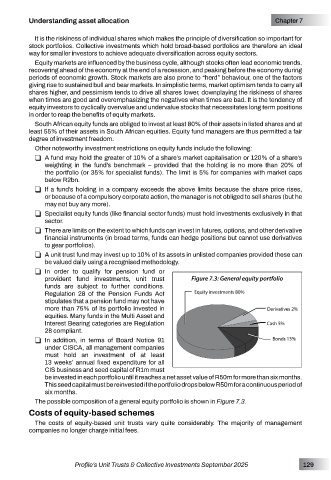
              provident  fund  investments,  unit  trust   Figure 7.3: General equity portfolio
              funds  are  subject  to  further  conditions.
              Regulation  28  of  the  Pension  Funds  Act
              stipulates that a pension fund may not have
              more than 75% of its portfolio invested in
              equities. Many funds in the Multi Asset and
              Interest Bearing categories are Regulation
              28 compliant.
           R   In  addition,  in  terms  of  Board  Notice  91
              under CISCA, all management companies
              must  hold  an  investment  of  at  least
              13  weeks’  annual  fixed  expenditure  for  all
              CIS business and seed capital of R1m must
              be invested in each portfolio until it reaches a net asset value of R50m for more than six months.
              This seed capital must be reinvested if the portfolio drops below R50m for a continuous period of
              six months.
           The possible composition of a general equity portfolio is shown in Figure 7.3.
         Costs of equity-based schemes
           The  costs  of  equity-based  unit  trusts  vary  quite  considerably.  The  majority  of  management
         companies no longer charge initial fees.


                      Profile’s Unit Trusts & Collective Investments September 2025    129

