


Page 51 - Profile's Unit Trusts & Collective Investments - March 2026
P. 51
Costs and pricing                                                     Chapter 3

           Annual costs are not the only issue. Entry costs such as
         initial charges or upfront advice fees also have an impact.   Real returns
         Today, very few managers or platforms charge product-  Real  returns  can  be  defined  as  net
         level initial fees, and most advice fees must be explicitly   investment  returns  achieved  after
         agreed  to  and  authorised  by  the  client  under  current   inflation. If inflation was 4% over the
         disclosure  regulations.  However,  upfront  advice  fees   year and a portfolio achieved 6% growth, the real
         are still used in certain distribution models, particularly   return was 2%. Rates of return before inflation are
         by tied agents and on some investment products sold to   called nominal returns.
         lower-income earners.
           When an initial advice fee is charged, the impact can be significant. At an upfront fee of 3.45%,
         investors  pay  R3  450  for  every  R100  000  invested.  In  a  fund  achieving  10%  per  annum,  this
         difference compounds to more than R23 000 over 20 years. It might be argued that this is not a
         significant  difference  given  that  R96  550  (the  capital  invested  after  payment  of  the  upfront  fee)
         would still grow to almost R650 000 over the same period, and that 3.45% is a reasonable price to
         pay for sound financial advice. However, R23 000 is not an insignificant amount. It highlights the
         importance of evaluating fees against the quality of advice received. There is little benefit in saving
         on costs but ending up in an inappropriate or mediocre fund. On the other hand, there is equally little
         value in paying advice fees only to be placed in an expensive active fund that underperforms lower-
         cost passive alternatives.
         Transactions
           Conceptually, the calculation of a price on a daily basis for each participatory interest in a CIS is
         straightforward: the market value of the portfolio is calculated, and this is divided by the number of
         units in issue.
           From the point of view of the management company, things are slightly more complicated. For a
         start, market values may need to be obtained from a number of different markets, both in SA and
         overseas. Once an accurate portfolio valuation is in place, the pricing department also deals with:
           R   Accrual of all interest and dividends due to the portfolio
           R   Distribution of interest and dividends when applicable
           R   Any liabilities against the fund (such as service fees, accrued audit fees, trustee fees, and so on)
           In  a  large  management  company,  the  administration  department  will  provide  the  pricing
         department with the number of units in issue at the close of trade, taking into account the sales of
         units, repurchases of units, and any switches that have taken place.
           The final price of each participatory interest, known as the net asset value price, can now be
         calculated by dividing the net portfolio value by the number of units. This is the price published in the
         daily and weekly newspapers, and is also the price at which units are repurchased.
         Purchase and repurchase
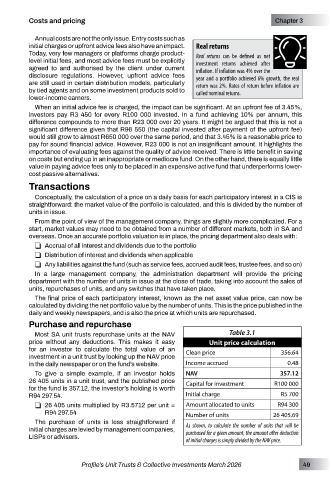
           Most  SA  unit  trusts  repurchase  units  at  the  NAV   Table 3.1
         price  without  any  deductions.  This  makes  it  easy   Unit price calculation
         for  an  investor  to  calculate  the  total  value  of  an   Clean price  356.64
         investment in a unit trust by looking up the NAV price
         in the daily newspaper or on the fund’s website.  Income accrued          0.48
           To  give  a  simple  example,  if  an  investor  holds     NAV        357.12
         26 405 units in a unit trust, and the published price   Capital for investment  R100 000
         for the fund is 357.12, the investor’s holding is worth
         R94 297.54.                                  Initial charge             R5 700
           R   26 405 units multiplied by R3.5712 per unit =   Amount allocated to units  R94 300
              R94 297.54                              Number of units          26 405.69
           The  purchase  of  units  is  less  straightforward  if
         initial charges are levied by management companies,   As  shown,  to  calculate  the  number  of  units  that  will  be
         LISPs or advisers.                           purchased for a given amount, the amount after deduction
                                                      of initial charges is simply divided by the NAV price.


                        Profile’s Unit Trusts & Collective Investments March 2026      49

