


Page 163 - Profile's Unit Trusts & Collective Investments - March 2026
P. 163
Fund manager interviews Chapter 9
Whether the rand strengthens or weakens over time, the strategy remains unchanged, and
positioning is determined solely by objective market signals. For investors, this ensures that returns
are driven by the underlying quality and performance of the portfolio, rather than by discretionary
views on exchange rates.
_ _ _ _ _ _ _ _ _ _ _ _ _ _ _ _ _ _ _ _ _ _ _ _ _ _ _ _ _ _ _ _ _ _ _ _ _ _ _ _ _ _ _ _ _ _ _ _ _ _ _ _ _ _ _ _ _ _ _ _ _ _ _
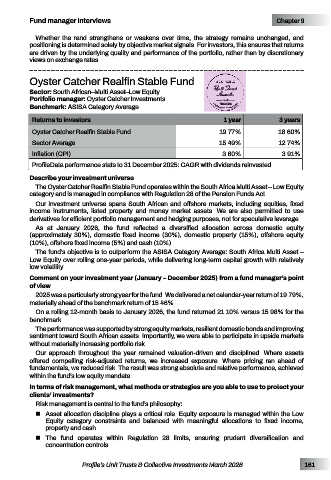
Oyster Catcher Realfin Stable Fund
Sector: South African–Multi Asset–Low Equity Unit Trust
Awards
Portfolio manager: Oyster Catcher Investments 2026
WINNER
Benchmark: ASISA Category Average For performance to 31 December 2025
Returns to investors 1 year 3 years
Oyster Catcher Realfin Stable Fund 19.77% 16.60%
Sector Average 15.49% 12.74%
Inflation (CPI) 3.60% 3.91%
ProfileData performance stats to 31 December 2025: CAGR with dividends reinvested
Describe your investment universe
The Oyster Catcher Realfin Stable Fund operates within the South Africa Multi Asset – Low Equity
category and is managed in compliance with Regulation 28 of the Pension Funds Act.
Our investment universe spans South African and offshore markets, including equities, fixed
income instruments, listed property and money market assets. We are also permitted to use
derivatives for efficient portfolio management and hedging purposes, not for speculative leverage.
As at January 2026, the fund reflected a diversified allocation across domestic equity
(approximately 30%), domestic fixed income (30%), domestic property (15%), offshore equity
(10%), offshore fixed income (5%) and cash (10%).
The fund’s objective is to outperform the ASISA Category Average: South Africa Multi Asset –
Low Equity over rolling one-year periods, while delivering long-term capital growth with relatively
low volatility.
Comment on your investment year (January – December 2025) from a fund manager’s point
of view
2025 was a particularly strong year for the fund. We delivered a net calendar-year return of 19.79%,
materially ahead of the benchmark return of 15.46%.
On a rolling 12-month basis to January 2026, the fund returned 21.10% versus 15.98% for the
benchmark.
The performance was supported by strong equity markets, resilient domestic bonds and improving
sentiment toward South African assets. Importantly, we were able to participate in upside markets
without materially increasing portfolio risk.
Our approach throughout the year remained valuation-driven and disciplined. Where assets
offered compelling risk-adjusted returns, we increased exposure. Where pricing ran ahead of
fundamentals, we reduced risk. The result was strong absolute and relative performance, achieved
within the fund’s low equity mandate.
In terms of risk management, what methods or strategies are you able to use to protect your
clients’ investments?
Risk management is central to the fund’s philosophy:
Asset allocation discipline plays a critical role. Equity exposure is managed within the Low
Equity category constraints and balanced with meaningful allocations to fixed income,
property and cash.
The fund operates within Regulation 28 limits, ensuring prudent diversification and
concentration controls.
Profile’s Unit Trusts & Collective Investments March 2026 161

