


Page 66 - Profile's Unit Trusts & Collective Investments - September 2025
P. 66
Chapter 3                                                     Costs and pricing

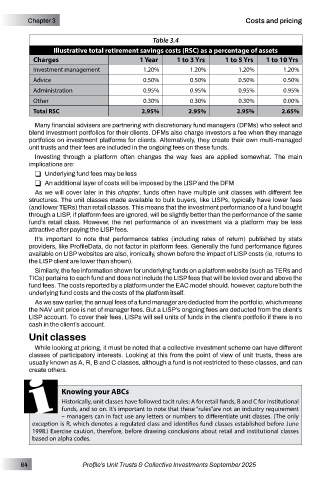
                                            Table 3.4
                Illustrative total retirement savings costs (RSC) as a percentage of assets
          Charges                        1 Year    1 to 3 Yrs    1 to 5 Yrs  1 to 10 Yrs
          Investment management           1.20%        1.20%         1.20%        1.20%
          Advice                          0.50%        0.50%         0.50%        0.50%
          Administration                  0.95%        0.95%         0.95%        0.95%
          Other                           0.30%        0.30%         0.30%        0.00%
          Total RSC                      2.95%         2.95%        2.95%        2.65%
           Many financial advisers are partnering with discretionary fund managers (DFMs) who select and
         blend investment portfolios for their clients. DFMs also charge investors a fee when they manage
         portfolios on investment platforms for clients. Alternatively, they create their own multi-managed
         unit trusts and their fees are included in the ongoing fees on these funds.
           Investing  through  a  platform  often  changes  the  way  fees  are  applied  somewhat.  The  main
         implications are:
           R   Underlying fund fees may be less
           R   An additional layer of costs will be imposed by the LISP and the DFM
           As we will cover later in this chapter, funds often have multiple unit classes with different fee
         structures. The unit classes made available to bulk buyers, like LISPs, typically have lower fees
         (and lower TERs) than retail classes. This means that the investment performance of a fund bought
         through a LISP, if platform fees are ignored, will be slightly better than the performance of the same
         fund’s  retail  class.  However,  the  net  performance  of  an  investment  via  a  platform  may  be  less
         attractive after paying the LISP fees.
           It’s  important  to  note  that  performance  tables  (including  rates  of  return)  published  by  stats
         providers, like ProfileData, do not factor in platform fees. Generally the fund performance figures
         available on LISP websites are also, ironically, shown before the impact of LISP costs (ie, returns to
         the LISP client are lower than shown).
           Similarly, the fee information shown for underlying funds on a platform website (such as TERs and
         TICs) pertains to each fund and does not include the LISP fees that will be levied over and above the
         fund fees. The costs reported by a platform under the EAC model should, however, capture both the
         underlying fund costs and the costs of the platform itself.
           As we saw earlier, the annual fees of a fund manager are deducted from the portfolio, which means
         the NAV unit price is net of manager fees. But a LISP’s ongoing fees are deducted from the client’s
         LISP account. To cover their fees, LISPs will sell units of funds in the client’s portfolio if there is no
         cash in the client’s account.
         Unit classes
           While looking at pricing, it must be noted that a collective investment scheme can have different
         classes of participatory interests. Looking at this from the point of view of unit trusts, these are
         usually known as A, R, B and C classes, although a fund is not restricted to these classes, and can
         create others.

                   Knowing your ABCs
                   Historically, unit classes have followed tacit rules: A for retail funds, B and C for institutional
                   funds, and so on. It’s important to note that these “rules”are not an industry requirement
                   – managers can in fact use any letters or numbers to differentiate unit classes. (The only
          exception is R, which denotes a regulated class and identifies fund classes established before June
          1998.) Exercise caution, therefore, before drawing conclusions about retail and institutional classes
          based on alpha codes.


       64                Profile’s Unit Trusts & Collective Investments September 2025

