


Page 27 - Profile's Unit Trusts & Collective Investments - March 2026
P. 27
History of collective investment schemes                              Chapter 1

                                               The  advent  of  prudential  funds  allowed  the  unit
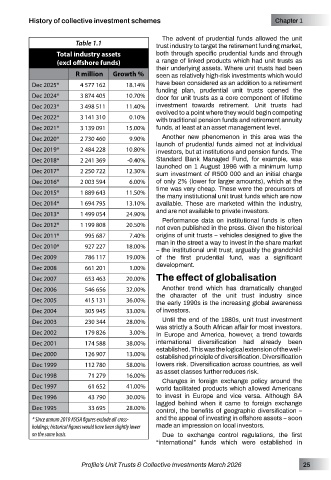
                       Table 1.1             trust industry to target the retirement funding market,
                 Total industry assets       both  through  specific  prudential  funds  and  through
                 (excl offshore funds)       a range of linked products which had unit trusts as
                                             their underlying assets. Where unit trusts had been
                       R million   Growth %  seen as relatively high-risk investments which would
          Dec 2025*     4 577 162    18.14%  have been considered as an addition to a retirement
                                             funding  plan,  prudential  unit  trusts  opened  the
          Dec 2024*     3 874 405    10.70%  door for unit trusts as a core component of lifetime
          Dec 2023*     3 498 511    11.40%  investment  towards  retirement.  Unit  trusts  had
                                             evolved to a point where they would begin competing
          Dec 2022*     3 141 310     0.10%  with traditional pension funds and retirement annuity
          Dec 2021*     3 139 091    15.00%  funds, at least at an asset management level.
          Dec 2020*     2 730 460     9.90%    Another  new  phenomenon  in  this  area  was  the
                                             launch  of  prudential  funds  aimed  not  at  individual
          Dec 2019*     2 484 228    10.80%  investors, but at institutions and pension funds. The
          Dec 2018*     2 241 369    -0.40%  Standard  Bank  Managed  Fund,  for  example,  was
                                             launched  on  1  August  1996  with  a  minimum  lump
          Dec 2017*     2 250 722    12.30%  sum  investment  of  R500  000  and  an  initial  charge
          Dec 2016*     2 003 594     6.00%  of only 2% (lower for larger amounts), which at the
                                             time was very cheap. These were the precursors of
          Dec 2015*     1 889 643    11.50%  the many institutional unit trust funds which are now
          Dec 2014*     1 694 795    13.10%  available.  These  are  marketed  within  the  industry,
                                             and are not available to private investors.
          Dec 2013*     1 499 054    24.90%
                                               Performance  data  on  institutional  funds  is  often
          Dec 2012*     1 199 808    20.50%  not even published in the press. Given the historical
          Dec 2011*      995 687      7.40%  origins of unit trusts – vehicles designed to give the
                                             man in the street a way to invest in the share market
          Dec 2010*      927 227     18.00%  – the institutional unit trust, arguably the grandchild
          Dec 2009       786 117     19.00%  of  the  first  prudential  fund,  was  a  significant
          Dec 2008       661 201      1.00%  development.
          Dec 2007       653 463     20.00%  The effect of globalisation
          Dec 2006       546 656     32.00%    Another  trend  which  has  dramatically  changed
                                             the  character  of  the  unit  trust  industry  since
          Dec 2005       415 131     36.00%  the  early  1990s  is  the  increasing  global  awareness
          Dec 2004       305 945     33.00%  of investors.
          Dec 2003       230 344     28.00%    Until  the  end  of  the  1980s,  unit  trust  investment
                                             was strictly a South African affair for most investors.
          Dec 2002       179 826      3.00%  In  Europe  and  America,  however,  a  trend  towards
          Dec 2001       174 588     38.00%  international  diversification  had  already  been
                                             established. This was the logical extension of the well-
          Dec 2000       126 907     13.00%  established principle of diversification. Diversification
          Dec 1999       112 780     58.00%  lowers risk. Diversification across countries, as well
                                             as asset classes further reduces risk.
          Dec 1998        71 279     16.00%
                                               Changes  in  foreign  exchange  policy  around  the
          Dec 1997        61 652     41.00%  world facilitated products which allowed Americans
          Dec 1996        43 790     30.00%  to  invest  in  Europe  and  vice  versa.  Although  SA
                                             lagged  behind  when  it  came  to  foreign  exchange
          Dec 1995        33 695     28.00%  control,  the  benefits  of  geographic  diversification  –
          * Since annum 2010 ASISA figures exclude all cross-  and the appeal of investing in offshore assets – soon
          holdings; historical figures would have been slightly lower   made an impression on local investors.
          on the same basis.                   Due  to  exchange  control  regulations,  the  first
                                             “international”  funds  which  were  established  in


                        Profile’s Unit Trusts & Collective Investments March 2026      25

