


Page 136 - Profile's Unit Trusts & Collective Investments - March 2026
P. 136
Chapter 8                                                 Classification of CISs


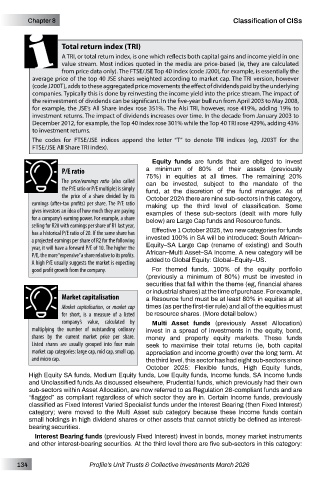
                   Total return index (TRI)
                   A TRI, or total return index, is one which reflects both capital gains and income yield in one
                   value stream. Most indices quoted in the media are price-based (ie, they are calculated
                   from price data only). The FTSE/JSE Top 40 index (code J200), for example, is essentially the
          average price of the top 40 JSE shares weighted according to market cap. The TRI version, however
          (code J200T), adds to these aggregated price movements the effect of dividends paid by the underlying
          companies. Typically this is done by reinvesting the income yield into the price stream. The impact of
          the reinvestment of dividends can be significant. In the five-year bull run from April 2003 to May 2008,
          for example, the JSE’s All Share index rose 351%. The Alsi TRI, however, rose 419%, adding 19% to
          investment returns. The impact of dividends increases over time. In the decade from January 2003 to
          December 2012, for example, the Top 40 index rose 301% while the Top 40 TRI rose 429%, adding 43%
          to investment returns.
          The  codes  for  FTSE/JSE  indices  append  the  letter  “T”  to  denote  TRI  indices  (eg,  J203T  for  the
          FTSE/JSE All Share TRI index).

                                            Equity funds  are  funds  that  are  obliged  to  invest
                   P/E ratio               a  minimum  of  80%  of  their  assets  (previously
                                           75%)  in  equities  at  all  times.  The  remaining  20%
                   The  price/earnings  ratio  (also  called   can  be  invested,  subject  to  the  mandate  of  the
                   the P/E ratio or P/E multiple) is simply   fund,  at  the  discretion  of  the  fund  manager.  As  of
                   the  price  of  a  share  divided  by  its   October 2024 there are nine sub-sectors in this category,
          earnings (after-tax profits) per share. The P/E ratio   making  up  the  third  level  of  classification.  Some
          gives investors an idea of how much they are paying   examples  of  these  sub-sectors  (dealt  with  more  fully
          for a company’s earning power. For example, a share   below) are Large Cap funds and Resource funds.
          selling for R20 with earnings per share of R1 last year,
          has a historical P/E ratio of 20. If the same share has   Effective 1 October 2025, two new categories for funds
          a projected earnings per share of R2 for the following   invested 100% in SA will be introduced: South African–
          year, it will have a forward P/E of 10. The higher the   Equity–SA  Large  Cap  (rename  of  existing)  and  South
          P/E, the more “expensive” a share relative to its profits.   African–Multi Asset–SA Income. A new category will be
          A high P/E usually suggests the market is expecting   added to Global Equity: Global–Equity–US.
          good profit growth from the company.  For  themed  funds,  100%  of  the  equity  portfolio
                                           (previously  a  minimum  of  80%)  must  be  invested  in
                                           securities that fall within the theme (eg, financial shares
                                           or industrial shares) at the time of purchase. For example,
                   Market capitalisation   a Resource fund must be at least 80% in equities at all
                   Market  capitalisation,  or  market  cap   times (as per the first-tier rule) and all of the equities must
                   for  short,  is  a  measure  of  a  listed   be resource shares. (More detail below.)
                   company’s  value,  calculated  by   Multi Asset funds  (previously  Asset  Allocation)
          multiplying  the  number  of  outstanding  ordinary   invest  in  a  spread  of  investments  in  the  equity,  bond,
          shares  by  the  current  market  price  per  share.     money  and  property  equity  markets.  These  funds
          Listed  shares  are  usually  grouped  into  four  main   seek  to  maximise  their  total  returns  (ie,  both  capital
          market cap categories: large cap, mid cap, small cap,   appreciation and income growth) over the long term. At
          and micro cap.                   the third level, this sector has had eight sub-sectors since
                                           October  2025:  Flexible  funds,  High  Equity  funds,
         High Equity SA funds, Medium Equity funds, Low Equity funds, Income funds, SA Income funds
         and Unclassified funds.As discussed elsewhere, Prudential funds, which previously had their own
         sub-sectors within Asset Allocation, are now referred to as Regulation 28-compliant funds and are
         “flagged” as compliant regardless of which sector they are in. Certain Income funds, previously
         classified as Fixed Interest Varied Specialist funds under the Interest Bearing (then Fixed Interest)
         category;  were  moved  to  the  Multi  Asset  sub  category  because  these  Income  funds  contain
         small holdings in high dividend shares or other assets that cannot strictly be defined as interest-
         bearing securities.
           Interest Bearing funds (previously Fixed Interest) invest in bonds, money market instruments
         and other interest-bearing securities. At the third level there are five sub-sectors in this category:


      134                 Profile’s Unit Trusts & Collective Investments March 2026

