


Page 106 - Profile's Unit Trusts & Collective Investments - September 2025
P. 106
Chapter 6                                                       Investment risk

         the ones that must be avoided. One objective of risk/return profiling is to identify such funds (see the
         risk/return profile charts in fact sheet tips).
           CISs are typically designed to reward with greater returns those investors who are prepared to take
         bigger risks. Long term studies of the performance of different asset classes (like property, bonds,
         cash and equities) invariably show the superior performance of the equity market over the long
         term. Over the vast majority of 10-year periods, historically, equities have on average outperformed
         property and bonds.
           But what does it really mean when we say that shares are more risky than fixed deposits? Is this
         always true, or only true for certain shares? Is it true regardless of the investment term (how long you
         invest for), and is it true whether you invest in SA or the US?


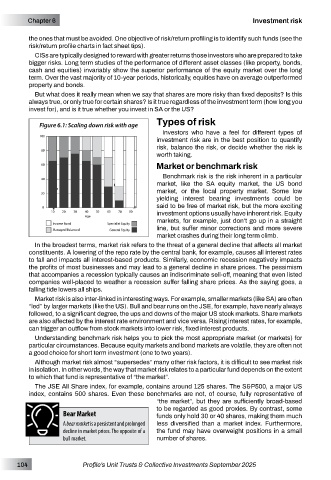
            Figure 6.1: Scaling down risk with age  Types of risk
                                               Investors  who  have  a  feel  for  different  types  of
                                              investment  risk  are  in  the  best  position  to  quantify
                                              risk,  balance  the  risk,  or  decide  whether  the  risk  is
                                              worth taking.

                                              Market or benchmark risk
                                               Benchmark risk is the risk inherent in a particular
                                              market,  like  the  SA  equity  market,  the  US  bond
                                              market,  or  the  local  property  market.  Some  low
                                              yielding  interest  bearing  investments  could  be
                                              said to be free of market risk, but the more exciting
                                              investment options usually have inherent risk. Equity
                                              markets, for example, just don’t go up in a straight
                                              line,  but  suffer  minor  corrections  and  more  severe
                                              market crashes during their long term climb.
           In the broadest terms, market risk refers to the threat of a general decline that affects all market
         constituents. A lowering of the repo rate by the central bank, for example, causes all interest rates
         to fall and impacts all interest-based products. Similarly, economic recession negatively impacts
         the profits of most businesses and may lead to a general decline in share prices. The pessimism
         that accompanies a recession typically causes an indiscriminate sell-off, meaning that even listed
         companies well-placed to weather a recession suffer falling share prices. As the saying goes, a
         falling tide lowers all ships.
           Market risk is also inter-linked in interesting ways. For example, smaller markets (like SA) are often
         “led” by larger markets (like the US). Bull and bear runs on the JSE, for example, have nearly always
         followed, to a significant degree, the ups and downs of the major US stock markets. Share markets
         are also affected by the interest rate environment and vice versa. Rising interest rates, for example,
         can trigger an outflow from stock markets into lower risk, fixed interest products.
           Understanding benchmark risk helps you to pick the most appropriate market (or markets) for
         particular circumstances. Because equity markets and bond markets are volatile, they are often not
         a good choice for short term investment (one to two years).
           Although market risk almost “supersedes” many other risk factors, it is difficult to see market risk
         in isolation. In other words, the way that market risk relates to a particular fund depends on the extent
         to which that fund is representative of “the market”.
           The JSE All Share index, for example, contains around 125 shares. The S&P500, a major US
         index,  contains  500  shares.  Even  these  benchmarks  are  not,  of  course,  fully  representative  of
                                              “the  market”,  but  they  are  sufficiently  broad-based
                                              to be regarded as good proxies. By contrast, some
                   Bear Market                funds only hold 30 or 40 shares, making them much
                   A bear market is a persistent and prolonged   less  diversified  than  a  market  index.  Furthermore,
                   decline in market prices. The opposite of a   the  fund  may  have  overweight  positions  in  a  small
                   bull market.               number of shares.


      104                Profile’s Unit Trusts & Collective Investments September 2025

